Friday, 18 April 2014

Are all Russians miserable gits? or Why do Russians never smile?

 One of the things British people complain about after visiting Russia and one of the things that might annoy you in your Russian colleagues or friends here in the UK is the fact Russians don't normally do social smiling.
  Russians struggle with it.
  They try really hard to get integrated into British society but this is something that just doesn't work with us, people born on the sixth of the world's surface.
  We don't smile without a reason.
   No wonder most Russians look like him to British public:
 
  Personally I think he is cute and adorable but an average Russian isn't that fluffy so our cuteness is something that reveals itself slowly.
  Those nice and kind British people who after visiting Moscow with horrible grumpy-looking Russians try to find an explanation for this usually come up with this one, "Russians were through a lot of misery during Soviet times and Stalin era so we can excuse their inability to smile".
  However the reasons might be much more complicated and go much deeper into history.

  In traditional Russian culture smiling or laughing without a reason was always seen as a sign of stupidity. Russia was a huge mostly agricultural country until the 20th century and smiling was out of the question for most of Russian farmers. Only a fool smiles without a reason. An intelligent person keeps a serious face.

  What about politeness one might ask?
  And here we come to a very interesting point: keeping a serious face while talking to somebody and avoiding smiling was actually seen as the only appropriate and polite behaviour!

  Why? How is that possible???
  In Russian culture if you don't smile and keep a strict face so to say it means you respect the person you are talking to because you are taking him or her seriously, listen to them attentively. 
A serious straight face also means that you are somebody who can be trusted. That you are an honest, reliable, serious person and you are not making fun out of your listener or laughing at them. A serious face means that you are giving them your undivided attention and take the conversation close to heart.

  It might sound absurd to British people but keeping a serious face when talking to someone actually did mean you were being polite and respectful towards them! 

  So next time you are in Moscow and those nasty Russian bastards don't smile to you - take it easy and think of this in the perspective I've suggested :) 
  

Saturday, 9 November 2013

Russian stereotypes about Britain and British

  Well, when I read this article in DM last night and looked through all those nasty comments I got really sad about the following: looks like DM is deliberately forming a very "specific" image of Russia in minds of Brits and encourages British people to get more "anti-Russian" myths.

 What does an average British person know about Russia?

  It's cold, there is Putin, everybody drinks vodka, there are bears with balalaikas everywhere, all Russians are drunkards and mafia people.
  That's basically it.
  Does an average British person know that Russia is a country of more than 200 different languages? That it has unbelievable variety of landscapes, cultures, time zones?

  Were the people who commented about "Russia being a primitive country" and "every Russian having a mental illness" keeping in mind great Russian literature, classical ballet, unique architecture? 

  British people have ENOUGH unfortunate  myths and stereotypes about Russia and Russians.

  Every newspaper - especially a big one such as Daily Mail - MUST have some social responsibility.
  Every author in a newspaper has to understand that he or she is responsible for what they write. For what they encourage.

  At the moment I can say that Daily Mail is responsible for this xenophobic wave of hatred towards Russians in comments.

  And the saddest thing is that it only adds to all those nasty "anti-Russian" myths.

  So - what about Russians then? What do average Russians think of Britain and British people?

  It might surprise somebody but Russians actually have quite positive stereotypes of the UK and people living in the country.
 1. Britain is the country of great English classical literature and specifically of Sherlock Holmes.
  There was a very successful and very popular TV-series in Soviet times about Sherlock Holmes.

To the left - Livanov (Sherlock Holmes), to the right - Solomin (Doctor Watson).
  Filmed in the times of Iron Curtain and total deficit this TV series became extremely popular. The whole film crew worked hard to make the film and everything in it look as English as possible - not an easy task in those days.
  It's an adorable movie classics now.
 2. Britain is the country of people with perfect manners.
  Russians may joke about it (here is one old Russian joke: a woman with lots of heavy bags gets on a bus. All seats are taken, mostly by men. She sighs and says to a big bloke sitting on a seat next to her, "Are there any gentlemen on this bus?", looking at him expectantly and hoping he will give her his seat. "There are plenty of gentlemen here!", responds the bloke, "There are no spare seats though!").
 
 So Russians may joke about that but "ladylike" and "gentleman" behaviour is something Russians strongly associate with Britain and British.
  All British people are polite and well-mannered - that's what most Russians think.
3. All British people are into sports, they are athletic sport-loving fit people.
  
This might have come from the general perception that Britain is the "cradle" of sport - especially football.
4. British people are well-educated.
   

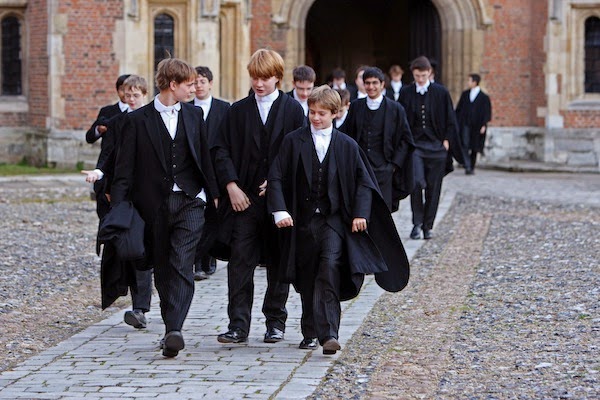
  This is of course strongly associated with boarding schools - though most Russians are aware that not every Brit goes to a public school there is still this idea that British people get educated in a very classical way, studying Latin, Ancient Greek and spending most of their youths with heavy books in their hands.

  I could go on with positive stereotypes Russians have about Britain and British: about five o'clock teas, cute old ladies in funny hats, about British people loving their pets dearly, about British people having healthy porridge for breakfast, etc. - but all in all those stereotypes are not bad, they are positive and quite friendly.

  And about this publication and comments in DM: you can have hostile perception of any and every nation. Is it really that good to be alienated? 


"Russians are far from the norm!" and "British people have more class!" Daily Mail

  Daily Mail posted a short article about what somebody named Hayley O'Keeffe called "Russian online dating".
  Here's the link http://www.dailymail.co.uk/news/article-2492393/Hilarious-images-singles-looking-love-Russian-dating-site.html.
  The person named H.O'Keeffe doesn't specify which dating website it is, instead uses lots of generalizing phrases like "desperate poses of Russians looking for love", "welcome to the world of Russian online dating".
  The person named H. O'Keeffe didn't bother herself looking up the words in the newspaper on one of the photos - otherwise she would know it's not Russian, it's Ukrainian actually.

  It doesn't matter however. What matters is that this publication "triggered" lots of very xenophobic and bullying comments.

Here are some of them,
"Russians are far from norm"
"Primitive country!"
"I want the Iron Curtain back!"
"Russia has never been the brightest nation!"
"To think we fought along side with this Filth in WW2 makes me vomit!"
"Russians are 30 years behind!"
"Exactly WHICH planet are Russians from?"
and the "best" - in my opinion "I have heard that every Russian has a mental condition due to genetics!"

  Apart from the fact that it is very xenophobic and it is cyber-bullying of an entire nation there are other aspects to that that bother me.

  The main one is the following: why would media want to form an unfortunate image like that of an entire nation? Of a big country with several time zones and nearly 300 different languages?

  Why would DM approve of and encourage xenophobic comments?
  How is it possible that in the country which is proud of fighting against racism one of the biggest and most popular newspapers allows articles like that and comments like that?

  Is being xenophobic any better than being a racist?

  Or, and that's an interesting bit - Are some animals still more equal that others? 

  Does DM really stand for the opinion that some countries (like Russia) are "primitive, 30 years behind, mentally ill" and that is why cyber-bullying of these countries is justified? 

  Because - Britain is much better than Russia so you can bully Russia and Russians as much as you like - they are a nation of a "third rate"?

Thursday, 17 October 2013

Being critical

  All those pointless megabytes of "Me and some stuff" photos in social networks!
  All those "who the f**k cares" details of one's own life!
  What a perfect way to create a virtual temple for worshiping yourself.

  For lots of people it IS already a Matrix - you can't encounter as many lies elsewhere but networks.
  

Tuesday, 8 October 2013

Women of the 50s

  Having seen 'Mona Lisa's Smile' which is on TV tonight several times before I keep thinking about enormous difference between Western and Soviet women in the 1950s.
  The story told in the film is about a college art teacher who challenges 'traditional values' of 1950-s women - marriage and family above all and everything. No career pursuit whatsoever, no job, just home life and housework - that was these middle-class young women's destiny, even though they were getting education good enough to become lawyers or corporate executives.
  One of the most remarkable scenes in this film (in my opinion) is Nancy Abbey's class in - I really don't know what to call this subject they were studying... Domestic Life? Being a Good Wife? Mastering the Art of Running a House? - when girls are supposed to roleplay solving the issue of a dinner party for their potential husband's boss and his colleague rivals.
  Lots and lots have been written on the subject of women's role in society after World War II - it was undoubtedly strongly associated with dinner parties, serving supper at 5 pm sharp, greeting a husband with a smile and a Martini - being home goddesses, whatever this slightly offensive phrase might mean.
  After the war - and this idea is neither fresh nor challenging - the world was striving to see women being as much feminine as possible.

    That's where this luxurious and submissive Dior's New Look came from - this 'highly feminine' fashion of high heels, corset-type dresses, red lipstick and girly curls.
  Women as home elves, fragile but hard working creatures, stunning at dinner parties and restless at housework.
  Women as expensive but totally dependent toys. Men's toys, of course. Men's possessions.
  One of the characters of the greatest 19th century Russian playwright Ostrovsky, Larisa Ogudalova, an outstandingly beautiful and charming young girl from a noble but impoverished family, claims that if she is supposed to be some man's possession the only way is to be an expensive one. Very cynical and tragic line reflecting on what women's destiny was (and is and will be) in a men powered world.
  And those college girls in the film were putting a lot of effort in making themselves very expensive assets for their future husbands - assets as valuable as possible, possessions to be proud of.
  Was it or was it not the only women's choice in 1950s Western world - being a perfect wife and mother - is another matter.
  The fact is women in the Soviet Union in the same decade were as far from this destiny of 'domestic goddesses' as never before.
  Total deficit was the main feature of the era - Soviet women couldn't even dream of luxurious clothes in Dior's New Look style. A pair of new stockings - that was a dream come true. Genuine perfume - a heavenly gift. 'Girly' little luxuries were so rare in those days and any attempts to look pretty were seen as inappropriate fussiness.
  Soviet women of the 50s had neither resources nor time to long for divine femininity of 'home goddesses' because they had to face the most fatal and devastating deficit - the lack of men, millions of which were killed at war.
  Most Soviet households in the 1950s were widowed women's desperate homes filled with despair, tears and struggle to get bread on the table.
  It was Soviet women who were rebuilding the country and the society in the 1950s. It was women who were raising kids, fixing railways and growing crops. Millions of desperate women whose feet were too 'worn out' for New Look high heels. Millions of widows who had their late husbands' photos hidden behind icons - in the last hope they might come back one day.
  They were absolutely free from being just someone's other half at home.
  They didn't have any chance to enjoy this luxury of just being a wife.
  Given this chance, would they choose New Look dresses and dinners at 5? 

Wednesday, 21 August 2013

"We were very lucky. They hardly ever sold us against our will!"

  Not so many Western people know that serfdom (which is basically slavery) existed in Russia up to 1861 when serfs (most of them peasants) were all freed thanks to Tsar Alexander II reform.
  Just for the sake of comparison: serfdom stopped existing in Britain in the XVth century.
  Slavery was abolished in the USA by 1865.
  So in terms of time there isn't considerable difference between Russia and the USA.
  When it comes to serfs' and slaves' rights I have to say both categories (in America as well as in Russia) were absolutely dependent on their owners' will. Russian serfs couldn't move against their owners' will, couldn't marry whoever they wanted, were seriously abused by their owners', had to rely completely on their owners' good will. 
  They were easily traded and their desire was never taken into account.
  It was a common thing among nobility to sell several serfs - or 'souls' as they were used to be called - for a couple of good hunting dogs (Russian nobility in the XIXth century were passionate hunters).
  My ancestors on my Mother's side were serfs. Slaves. Without any rights whatsoever - they could be sold, whipped to death, robbed or raped by their owners.
  However, our family history says the nobility owning us were quite liberal. As my great-grandmother used to say, "They were kind and merciful and never sold us against our will!"
  Serfdom (slavery) didn't stop people from being talented artists, composers, poets and actors.
  One of the most famous and most romantic love stories is the one of Parasha Kovaleva-Zhemchugova, a serf actress, who secretly got married to her owner, Count Sheremetyev - marriage almost impossible in the early XIXth century. 
  

Thursday, 8 August 2013

'First they came for....'

  I have just been pointed out that one very famous quote could be applied to the current situation in Russia.
  It's the one by Martin Niemoeller:
First they came for the communists,
and I didn't speak out because I wasn't a communist.
Then they came for the socialists,
and I didn't speak out because I wasn't a socialist.
Then they came for the trade unionists,
and I didn't speak out because I wasn't a trade unionist.
Then they came for the Jews,
and I didn't speak out because I wasn't a Jew.
Then they came for the Catholics,
and I didn't speak out because I wasn't a Catholic.
Then they came for me,
and there was no one left to speak for me.

Anybody who is different. Anybody who stands out.